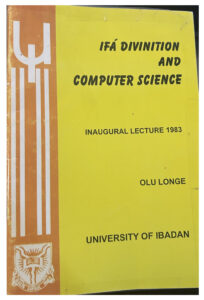
This obscure little book (difficult to find and purchase today) was written in 1983 and published in 1998. It’s just about 50 pages. It is only available today from the University of Ibadan bookstore —— not sure if it’s still available as I ordered one of the remaining few copies left in 2022.
Olu Longe was Nigeria’s first professor of computer science.
Longe was awarded the BSc degree in Physics from the University of London (through the then University College, Ibadan, now University of Ibadan) in 1959. He graduated with the MSc degree in Computer Science from the University of Sydney, Australia (1966) and a PhD degree in Computer Science from Ohio State University, USA (1974).
In this book Longe shows how the Ifá knowledge system uses a binary system with statistical computation for decision making. He first outlines the basic concepts of computer science then reveals how these concepts are contained in the Ifá knowledge system including:
(i) Binary digit (bit) (ii) Representation of basic characters (iii) Coding (iv) Boolean algebra and logic (v) Computer memory organization and addressing (vi) Matrices.
Regarding the basic unit of data and addressing, Longe explains that:
“It was not until 1964 that the 8-bit ‘byte’ was adopted as the standard unit of computer data, and since then, the smallest addressable area of computer memory has been the 8-bit byte. The 8-bit byte had been the standard unit of data in Ifá, centuries before 1964.”
In The Mystery of the Binary (2003), Viznut explains:
“Eight bits is not merely the length of an Ifá, but also the word length of the microcomputer revolution.”
I cite Olu Longe in my recent piece for the LSE Impact Blog ‘What Ifá, an Indigenous binary knowledge system can teach us about AI’
Longe is also cited in my 2024 paper ‘An Ancient African Knowledge System’s Resurgence in the Age of AI’